
I still remember a job site inspection I conducted at a distribution warehouse just outside Dallas, Texas. A new hire—barely two weeks into the job—froze when a coworker’s sleeve got caught in a moving conveyor. Instead of hitting the emergency stop immediately, he hesitated, unsure if he was “allowed” to use it.
That hesitation lasted maybe three seconds. But in conveyor-related incidents, three seconds can mean the difference between a close call and a permanent injury.
Fortunately, a seasoned operator slammed the emergency stop cord in time. The worker walked away with minor bruising instead of a life-altering injury. But I’ve seen situations where that hesitation ended very differently.
This guide is built from real field experience, OSHA compliance standards, and what actually happens on American job sites—not textbook theory. If you work around conveyor systems in warehouses, manufacturing plants, or logistics hubs, understanding how and when to use an emergency stop (E-stop) is not optional—it’s critical.
Whether you’re in a fulfillment center in California, a food processing plant in Illinois, or a packaging facility in Florida, the principles remain the same—but enforcement and expectations can vary. Let’s start with the legal and industry realities shaping conveyor safety in 2026.
2026 Industry Landscape & OSHA Legal Standards
Why Emergency Stop Systems Are Under Scrutiny in 2026
Conveyor systems are everywhere in the U.S. economy—from Amazon-style fulfillment centers to automotive plants in Michigan. But with increased automation comes increased risk.
According to the Bureau of Labor Statistics (BLS), workplace injuries involving machinery and conveyors continue to account for thousands of incidents annually. Many of these are preventable—and a large percentage involve improper or delayed use of emergency stop systems.
In my audits, I consistently see one major issue: workers are trained on “where” the E-stop is—but not “when” and “how” to use it under pressure.
Key OSHA Regulations You Must Know
The Occupational Safety and Health Administration (OSHA) doesn’t treat emergency stops as optional safety features—they are a mandatory control mechanism under multiple standards.
1. Machine Guarding – OSHA 29 CFR 1910.212
- Requires protection from moving parts
- Emergency stops act as a secondary safety control
- Must be easily accessible and clearly visible
2. Lockout/Tagout (LOTO) – OSHA 29 CFR 1910.147
- Governs energy control during maintenance
- Critical distinction:
- E-stop = immediate hazard control
- LOTO = long-term energy isolation
One of the biggest mistakes I’ve seen is workers assuming hitting the E-stop makes equipment “safe.” It does not. It only stops motion temporarily.
3. OSHA General Duty Clause
- Employers must provide a workplace free from recognized hazards
- Failure to maintain functional E-stop systems can result in heavy penalties
State-Level Enforcement: Why Location Matters
While OSHA sets federal standards, enforcement intensity varies by state.
- California (Cal/OSHA): Known for aggressive inspections and higher penalties
- Texas: Follows federal OSHA, but enforcement can vary by region
- New York: Strong focus on worker training and documentation
In one California case I reviewed, a company was fined over $70,000 because an emergency stop cord was partially blocked by stored inventory. The system existed—but it wasn’t usable in an emergency.
Types of Emergency Stop Systems Used in U.S. Facilities
From my field inspections, these are the most common systems you’ll encounter:
1. Pull Cord (Cable) Systems
- Runs along the conveyor length
- Activated by pulling the cord from any point
- Common in large warehouses
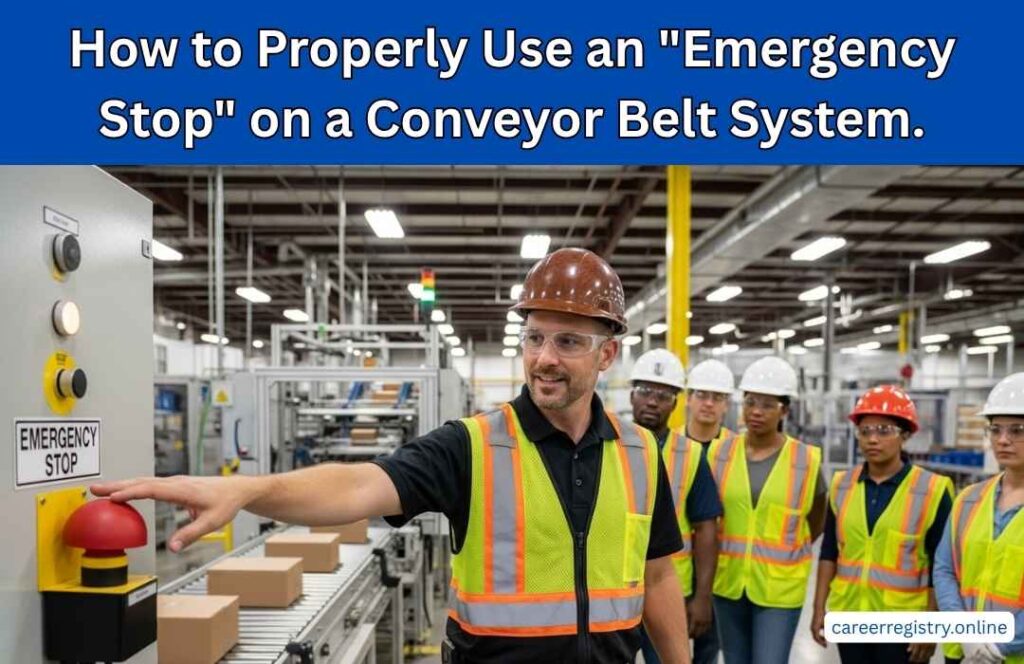
2. Push Button E-Stops
- Red mushroom-style buttons
- Typically located at control panels
- Require close proximity
3. Trip Wire Systems
- Similar to pull cords but more sensitive
- Used in high-risk areas
Pro Insight: In fast-paced environments like e-commerce fulfillment centers, pull cord systems are often the most effective—because workers don’t need to locate a button under stress.
Employer vs Worker Responsibility
Employer Must:
- Install compliant E-stop systems
- Ensure accessibility (no obstructions)
- Provide hands-on training
- Conduct regular inspections
Worker Must:
- Know the exact location of E-stops
- Use them without hesitation in emergencies
- Never bypass or disable safety systems
Here’s something I always tell trainees:
“If you’re wondering whether to hit the emergency stop—hit it. Equipment can be restarted. Lives can’t.”
Common Compliance Failures I See in the Field
After years of OSHA consulting, these are the top violations I encounter:
- Emergency stops blocked by pallets or boxes
- Workers afraid to use E-stops due to production pressure
- Lack of refresher training
- Faulty or non-functional stop systems
- No clear reset procedures
One facility in Ohio had fully installed E-stops—but half the workforce didn’t know they existed. That’s a compliance failure—and a serious risk.
Safety Disclaimer
This article is for educational and career guidance purposes only. Always follow your employer’s official safety procedures and OSHA regulations. When in doubt, consult a certified safety professional or OSHA representative.
In the next section, we’ll break down exactly how to use an emergency stop system step-by-step, including when to activate it, when not to, and how to safely reset the system without creating new hazards.
Step-by-Step Technical Guide to Using Emergency Stops on Conveyor Systems
When I train workers on-site—whether it’s a packaging facility in Illinois or a logistics hub in Georgia—I emphasize one thing above all:
Emergency stop usage must become muscle memory, not a decision-making process.
In real emergencies, you won’t have time to think through procedures. You’ll react based on training. So let’s build that foundation properly.
Step 1: Identify Your Nearest Emergency Stop Before You Start Work
Before your shift even begins, locate:
- The nearest pull cord or trip wire
- The closest push-button E-stop
- Backup stop locations within your work zone
Pro Tip (From Field Experience):
I’ve seen workers rely on “I’ll find it if needed.” That mindset fails under stress. During one audit in Chicago, a worker ran 20 feet looking for a button while a jam escalated into a serious hazard.
Make it a habit:
Every shift = quick mental map of E-stop locations.
Step 2: Recognize Situations That Require Immediate Activation
You should activate an emergency stop immediately in any of these scenarios:
- A person is caught, pinned, or pulled into the conveyor
- Clothing, hair, or PPE gets entangled
- A product jam creates unsafe pressure buildup
- Equipment begins behaving abnormally (jerking, grinding, misalignment)
- A coworker signals distress
What I tell trainees:
“You are not shutting down production—you are preventing an incident report.”
Step 3: Activate the Emergency Stop Without Hesitation
Depending on system type:
Pull Cord System
- Grab firmly and pull downward or outward
- Do not “test pull”—commit fully
Push Button System
- Slam the red mushroom button with your palm
- Don’t press lightly—ensure full engagement
Trip Wire System
- Any forceful contact should trigger it
- If not, treat it as a system failure and report immediately
Critical Insight:
In high-stress moments, fine motor skills drop. That’s why E-stop systems are designed for gross motor actions—pulling or striking.
Step 4: Do NOT Attempt to Fix the Problem Immediately
This is where many workers make dangerous mistakes.
After activating the E-stop:
- Step away from moving parts
- Alert supervisors immediately
- Ensure no one attempts a restart
I’ve personally investigated an incident in Houston, Texas where a worker hit the E-stop correctly—but then tried to free a jammed box. The system restarted unexpectedly, leading to a hand injury.
Step 5: Follow Proper Lockout/Tagout (LOTO) Procedures
This is where OSHA compliance becomes critical.
The Occupational Safety and Health Administration clearly distinguishes:
- Emergency Stop = temporary halt
- Lockout/Tagout = full energy isolation
Only trained personnel should:
- Disconnect power sources
- Apply lockout devices
- Verify zero energy state
Never assume a stopped conveyor is a safe conveyor.
Step 6: Resetting the Emergency Stop Safely
Resetting is not just “turning it back on.”
Proper reset procedure:
- Identify and resolve the root issue
- Ensure all personnel are clear
- Supervisor approval (in most facilities)
- Reset E-stop (twist/pull button or reset cord system)
- Restart system gradually
Pro Tip:
If you didn’t see what caused the stop—don’t be the one to reset it.
Real-World Case Scenarios & Data Comparison
Case Study 1: Warehouse Incident – Near Chicago, Illinois
A worker noticed a box jam but delayed hitting the E-stop, assuming maintenance would handle it.
Outcome:
- Conveyor overload caused mechanical failure
- Debris struck a nearby employee
- Result: OSHA recordable injury
Root Cause: Hesitation + misunderstanding of responsibility
Case Study 2: Manufacturing Plant – Dallas, Texas
A machine operator immediately pulled the E-stop when a coworker’s glove got caught.
Outcome:
- Conveyor stopped within seconds
- No injury
- Incident logged as “near miss”
Root Cause of Success: Immediate action + proper training
Case Study 3: Food Processing Facility – California
An E-stop cord was partially blocked by stacked inventory.
Outcome:
- Worker couldn’t reach cord in time
- Severe hand injury
- Employer cited under OSHA violations
Root Cause: Poor workplace organization + compliance failure
Data Table: Proper vs Improper Emergency Stop Usage
| Scenario | Reaction Time | Outcome | OSHA Impact |
|---|---|---|---|
| Immediate E-stop activation | 1–2 seconds | No injury / near miss | Positive safety record |
| Delayed activation | 3–6 seconds | Minor to serious injury | OSHA investigation likely |
| No E-stop usage | 5+ seconds | Severe injury/fatality | Heavy fines & violations |
| Blocked E-stop access | N/A | High injury risk | Employer liability |
| Improper reset procedure | N/A | Secondary accidents | Training violation |
Common Mistakes I See Repeatedly
After years in the field, these patterns show up across nearly every facility:
1. Hesitation Due to Fear of “Getting in Trouble”
Workers worry about stopping production. This is a cultural failure—not a worker failure.
2. Treating E-Stop as a “Last Resort”
It’s not. It’s a first response tool.
3. Not Knowing Reset Procedures
Improper resets cause secondary incidents more often than people realize.
4. Ignoring Small Warning Signs
Minor jams often become major hazards within seconds.
A Veteran’s Rule You Should Remember
“If something feels wrong on a conveyor system, it already is.”
Trust your instincts. Every serious accident I’ve investigated had early warning signs that were ignored.
Health, Longevity, and Salary Growth Secrets in Conveyor Safety Careers
After years of working as both a career counselor and OSHA safety consultant across facilities in California, Texas, and the Midwest, I can tell you this:
Workers who take safety seriously don’t just avoid injuries—they build better, higher-paying careers.
Emergency stop knowledge might seem like a small skill. It’s not. It signals to employers that you are:
- Situationally aware
- Reliable under pressure
- Trainable for leadership roles
And those traits directly impact your earning potential.
The Hidden Health Risks You Avoid by Using E-Stops Properly
Most workers think conveyor accidents are always dramatic. In reality, many injuries are:
- Gradual
- Preventable
- Career-ending over time
Common Long-Term Injuries I’ve Seen:
- Hand and finger crush injuries
- Repetitive strain injuries from clearing jams manually
- Back injuries from improper intervention
- Psychological stress after workplace incidents
According to the Bureau of Labor Statistics, workplace injuries involving machinery often lead to extended time away from work, and in many cases, permanent job limitations.
Real Insight:
One worker I counseled in Ohio avoided a serious injury by using an E-stop correctly. That single action kept him in the workforce—and later helped him get promoted.
How Safety Skills Directly Increase Your Salary
Employers don’t just pay for labor—they pay for risk reduction.
Workers who demonstrate strong safety awareness often move into:
- Lead operator roles
- Shift supervisor positions
- Safety coordinator jobs
Typical Salary Progression in the U.S. (2026 Estimates)
| Role | Experience Level | Avg Salary (USD) |
|---|---|---|
| Warehouse Associate | Entry-level | $32,000–$40,000 |
| Conveyor System Operator | 1–3 years | $40,000–$52,000 |
| Lead Operator / Team Lead | 3–5 years | $52,000–$65,000 |
| Safety Coordinator | 5+ years | $65,000–$85,000 |
| OSHA Safety Specialist | Advanced | $80,000–$110,000 |
Pro Tip (From Hiring Experience):
When I interview candidates, those who can clearly explain when and why to use an emergency stop instantly stand out. It shows real-world competence—not just training completion.
Certifications That Boost Your Career Fast
If you want to turn safety knowledge into income growth, focus on these:
1. OSHA 10-Hour Certification
- Entry-level credential
- Required by many employers
2. OSHA 30-Hour Certification
- Preferred for supervisors
- Covers advanced safety practices
3. Certified Safety Professional (CSP)
- High-level certification
- Opens doors to six-figure roles
4. Forklift & Equipment Safety Training
- Often combined with conveyor operations
- Increases job flexibility
What I Tell Workers:
“Your first raise often comes from skills—not seniority.”
Career Growth Strategy Most Workers Miss
Here’s a pattern I’ve observed across hundreds of job sites:
Workers who:
- Report hazards
- Use E-stops correctly
- Follow procedures consistently
…are the same ones supervisors trust.
And trust leads to:
- Promotions
- Better shifts
- Higher pay
How Safety Awareness Protects Your Long-Term Earning Potential
A single injury can:
- Remove you from physically demanding roles
- Limit overtime opportunities
- Force a career change
By contrast, strong safety habits:
- Extend your working life
- Keep you eligible for promotions
- Build a reputation that follows you across employers
FAQs
1. Can I get in trouble for using an emergency stop unnecessarily?
In most U.S. workplaces, no—as long as your intent was safety.
The Occupational Safety and Health Administration supports proactive hazard prevention. Employers should encourage E-stop use when risk is perceived.
2. What’s the difference between an emergency stop and a normal stop?
Normal stop: Controlled shutdown during routine operations
Emergency stop: Immediate halt during unsafe conditions
Emergency stops bypass normal controls and should only be used in urgent situations.
3. How fast does a conveyor stop after pressing an E-stop?
Most systems stop within 1–3 seconds, depending on:
1. Conveyor speed
2. Load weight
3. System design
However, even a 1-second delay can matter in high-risk situations.
4. Is it safe to restart a conveyor after hitting the E-stop?
Only after:
1. Identifying the cause
2. Ensuring all workers are clear
3. Following proper reset procedures
Never restart blindly—this is a common cause of secondary accidents.
5. Are employers required to train workers on E-stop usage?
Yes. Under OSHA standards, employers must provide:
1. Hazard communication
2. Equipment training
3. Safe operation procedures
Lack of training can result in violations and penalties.
6. What should I do if an emergency stop is blocked or not working?
1. Report it immediately to a supervisor
2. Do not operate the equipment
3. Document the hazard if possible
Blocked or faulty E-stops are serious compliance issues.
Final Safety Reminder
This content is for educational purposes only. Always follow your company’s official safety procedures and OSHA regulations. When in doubt, consult a certified safety professional.
Conclusion
Using an emergency stop on a conveyor system isn’t just a technical skill—it’s a professional responsibility that directly impacts lives. From my field experience across U.S. job sites, the workers who act quickly, confidently, and correctly are the ones who prevent injuries and earn long-term trust from employers.
If you take one thing from this guide, let it be this: never hesitate when safety is at risk. Learn your equipment, understand OSHA expectations, and treat every shift like preparation for a real emergency. That mindset doesn’t just keep you safe—it builds a career that grows in stability, respect, and income.
Also Check:- How to Answer: “Tell Me About a Time You Spotted a Safety Hazard in the Warehouse.”