
Over the past decade, working as both a career counselor and a certified OSHA safety consultant across states like Texas, California, and Illinois, I’ve reviewed hundreds of warehouse resumes—from entry-level pickers to experienced forklift operators and supervisors. And I’ll be blunt: most of them fail within the first 10 seconds.
Not because the workers lack experience—but because their resumes sound generic.
I constantly see phrases like:
- “Worked in a warehouse.”
- “Helped with loading.”
- “Responsible for inventory.”
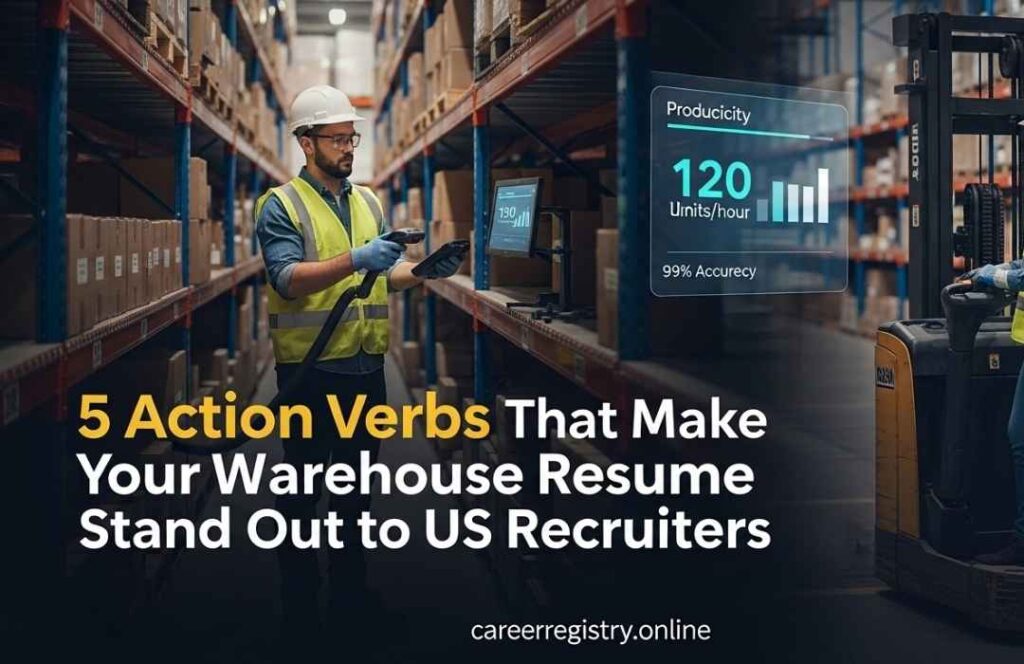
These phrases don’t tell recruiters anything. In a hiring environment where companies like Amazon, UPS, and Walmart Distribution Centers receive thousands of applications weekly, vague wording gets ignored.
Here’s the reality: US recruiters skim resumes in about 6–8 seconds. During that time, they’re not just looking for experience—they’re scanning for proof of productivity, safety awareness, and efficiency.
That’s where action verbs come in.
Using the right action verbs on your warehouse resume doesn’t just make it sound better—it signals that you understand operational efficiency, compliance, and performance metrics. These are exactly the traits employers prioritize in 2026’s fast-evolving logistics industry.
In this guide, I’ll break down the 5 action verbs that make your warehouse resume stand out to US recruiters, along with real-world insights from the warehouse floor and hiring side.
Table of Contents
2026 Warehouse Industry Landscape & Legal Standards (USA)
If you want your resume to stand out, you first need to understand the industry you’re applying to. And right now, the US warehouse and logistics sector is undergoing a major transformation.
The 2026 Hiring Landscape (What Recruiters Are Actually Looking For)
According to the U.S. Bureau of Labor Statistics, employment in the logistics and material moving sector continues to grow steadily, driven by e-commerce expansion and supply chain restructuring. States like California, Texas, and Pennsylvania remain hotspots due to large distribution networks.
From my on-site consulting work, I’ve noticed three key hiring priorities in 2026:
- Speed + Accuracy
Employers want workers who can meet high pick rates without errors. - Safety Awareness
OSHA compliance is no longer optional—it’s a baseline expectation. - Adaptability with Technology
Warehouses now use scanners, warehouse management systems (WMS), and automation tools.
If your resume doesn’t reflect these qualities clearly, you’re already at a disadvantage.
Why OSHA Language Matters More Than Ever
As someone who has conducted safety audits in multiple distribution centers, I can tell you this: companies are terrified of safety violations.
The Occupational Safety and Health Administration (OSHA) enforces strict workplace safety standards under regulations like 29 CFR 1910, which covers general industry practices—including warehouse operations.
Here’s a pro tip most job seekers don’t know:
Resumes that include safety-focused action verbs get more callbacks.
Why?
Because hiring managers are trained to reduce risk. When they see words like:
- “Inspected”
- “Maintained compliance”
- “Reduced incidents”
…it signals that you’re not just a worker—you’re someone who helps prevent costly accidents.
The Role of US Labor Laws in Hiring Decisions
Another overlooked factor is compliance with wage and labor laws.
The Fair Labor Standards Act (FLSA) governs minimum wage, overtime pay, and working hours. Employers prefer candidates who understand structured work environments and productivity tracking.
From experience, warehouse supervisors often favor resumes that demonstrate:
- Time efficiency
- Task completion under deadlines
- Overtime reliability
This is where action verbs tied to measurable output become powerful.
What Top US Warehouse Employers Expect in 2026
Let me give you a real-world snapshot from facilities I’ve worked with:
In a Dallas distribution center, a hiring manager once told me:
“I don’t care how many years someone worked. I care what they actually did—and how well they did it.”
That’s the mindset across major employers today.
Recruiters are looking for:
- Clear evidence of performance (units picked, orders processed)
- Safety compliance awareness
- Team coordination experience
- Process improvement contributions
If your resume says:
“Responsible for packing items.”
…it sounds passive.
But if it says:
“Executed high-volume order packing with 99.8% accuracy while maintaining OSHA safety standards.”
…it immediately stands out.
Common Resume Mistakes I See on the Warehouse Floor
Here are the most frequent mistakes I’ve personally seen:
1. Using weak, repetitive verbs
- “Did,” “worked,” “helped.”
2. No numbers or metrics
- No mention of productivity or accuracy
3. Ignoring safety completely
- No OSHA-related language
4. Copy-paste resumes
- Not tailored to the job description
One candidate I worked with in Chicago had 5 years of experience—but kept getting rejected. We changed just the wording on his resume, using strong action verbs and added measurable results.
Within 3 weeks, he had 3 interview calls.
Why Action Verbs Are Your Competitive Advantage
In today’s job market, your resume is not just a summary—it’s a marketing document.
Strong action verbs:
- Show ownership of tasks
- Highlight results, not duties
- Align with ATS (Applicant Tracking Systems)
- Signal professionalism and competence
And most importantly—they help recruiters quickly answer one question:
“Can this person perform and stay safe on the job?”
Step-by-Step Guide – How to Use Action Verbs Strategically
When I coach warehouse workers—from entry-level associates in New Jersey to forklift operators in California—the biggest transformation always comes from one simple shift: changing how they describe their work.
This isn’t about fancy words. It’s about precision, clarity, and proof of performance.
Here’s the exact system I use with clients to upgrade their resumes.
Step 1: Identify What You Actually Did (Not Your Job Title)
Most people start with job titles. That’s a mistake.
Recruiters don’t hire job titles—they hire skills and results.
Instead of writing:
- “Warehouse Associate at XYZ Logistics”
Break it down into actual tasks:
- Picking orders
- Packing shipments
- Operating pallet jacks or forklifts
- Scanning inventory
- Loading/unloading trucks
- Following safety protocols
Pro Tip (From My Field Experience):
I’ve seen workers underestimate their experience because they “just followed instructions.” In reality, they were performing high-volume, time-sensitive operations. That’s valuable—if you describe it correctly.
Step 2: Replace Weak Verbs with High-Impact Action Verbs
Now take each task and replace weak verbs with strong ones.
| Weak Verb | Strong Alternative |
|---|---|
| Worked | Executed |
| Helped | Assisted / Coordinated |
| Did | Performed / Completed |
| Responsible for | Managed / Oversaw |
Example transformation:
- Weak: “Worked on loading trucks”
- Strong: “Executed efficient truck loading operations”
Notice the difference? The second version shows ownership and competence.
Step 3: Add Metrics (This Is Where Most People Fail)
If you skip this step, your resume will still blend in.
Numbers are what make recruiters stop and pay attention.
Add:
- Units per hour
- Accuracy rate
- Team size
- Time saved
- Safety record
Example:
- “Executed order picking operations at 120+ items/hour with 99% accuracy”
Real Insight:
In a warehouse I audited in Illinois, workers hitting 100+ picks/hour were top performers. When those numbers appeared on resumes, they got interviews faster.
Step 4: Align with ATS (Applicant Tracking Systems)
Most large employers use ATS software to filter resumes before a human even sees them.
That means your wording must match job descriptions.
If a job posting mentions:
- “Inventory control”
- “Material handling”
- “OSHA compliance”
…your resume should include those exact phrases.
Pro Tip:
Don’t keyword-stuff. Use action verbs naturally:
- “Managed inventory control processes using RF scanners”
- “Maintained OSHA-compliant material handling procedures”
Step 5: Customize for Each Job (Non-Negotiable in 2026)
This is where serious candidates separate themselves.
Never send the same resume to every job.
Instead:
- Read the job description carefully
- Identify 3–5 key skills
- Adjust your verbs and bullet points accordingly
Example:
If applying to a safety-focused role:
- Emphasize “inspected,” “maintained,” “complied”
If applying to a high-speed fulfillment center:
- Emphasize “executed,” “optimized,” “streamlined”
The 5 High-Impact Action Verbs + Real-World Examples
Now let’s get into the core of this guide—the 5 action verbs that consistently get attention from US recruiters.
These are not random. These are based on what I’ve seen work in real hiring environments.
1. Coordinated
This shows teamwork and operational flow.
Before:
- “Helped with shipments”
After:
- “Coordinated inbound and outbound shipments to ensure timely delivery”
Where it shines:
- Team-based environments
- Dock operations
- Multi-step workflows
2. Optimized
This signals efficiency and improvement—something every employer wants.
Before:
- “Packed orders”
After:
- “Optimized packing processes to reduce material waste by 15%”
Pro Insight:
Even small improvements matter. If you rearranged your station for speed—that’s optimization.
3. Executed
This is one of the strongest verbs you can use. It shows action and accountability.
Before:
- “Did order picking”
After:
- “Executed high-volume order picking in a fast-paced environment”
4. Inspected
This is gold from a safety perspective.
It immediately signals awareness of compliance and risk prevention.
Before:
- “Checked equipment”
After:
- “Inspected equipment and work areas to ensure OSHA compliance”
Hiring managers love this because it reduces liability.
5. Streamlined
This highlights process improvement and efficiency.
Before:
- “Organized inventory”
After:
- “Streamlined inventory organization, reducing retrieval time by 20%”
Real-World Resume Transformation Example
Here’s a direct comparison I’ve used with clients:
Before (Typical Resume)
- Worked in warehouse
- Helped load trucks
- Responsible for inventory
After (Optimized Resume)
- Executed high-volume warehouse operations with consistent productivity targets
- Coordinated truck loading to ensure on-time dispatch
- Streamlined inventory processes, improving accuracy and efficiency
Detailed Comparison Table (Weak vs Strong Resume Language)
| Category | Weak Resume | Strong Resume |
|---|---|---|
| Action Verb | Worked | Executed |
| Task Description | Helped with loading | Coordinated loading operations |
| Metrics | None | 100+ units/hour |
| Safety Mention | Missing | Inspected for OSHA compliance |
| Impact | Unclear | Quantified results |
Case Scenario: Entry-Level vs Experienced Worker
Entry-Level Candidate (New Jersey Applicant)
Weak:
- “Helped in warehouse operations.”
Strong:
- “Assisted in order fulfillment operations, maintaining accuracy in a high-volume environment.”
Experienced Worker (Texas Forklift Operator)
Weak:
- “Operated forklift”
Strong:
- “Executed safe forklift operations while maintaining compliance with OSHA standards and achieving daily productivity targets.”
What Recruiters Actually Think (From My Conversations)
I’ve sat with hiring managers in multiple facilities, and they all say the same thing:
“If a resume shows impact, we call them. If it shows duties, we skip.”
That’s the difference action verbs make.
Health, Longevity, & Salary Growth in Warehouse Careers
After years of working inside distribution centers—from safety audits in California to workforce training sessions in Texas—I’ve seen two types of warehouse workers:
- Those who treat the job as temporary and burn out quickly
- Those who build long-term, higher-paying careers
The difference isn’t luck. It’s strategy, safety habits, and positioning—and your resume plays a bigger role than you think.
Why Health & Safety Directly Impact Your Career Growth
Warehouse work is physically demanding. According to the U.S. Bureau of Labor Statistics, injury rates in transportation and warehousing remain higher than many other industries.
From my OSHA inspections, the most common issues I’ve seen are:
- Improper lifting techniques
- Repetitive strain injuries
- Forklift-related incidents
- Slips, trips, and falls
Here’s what most workers don’t realize:
Employers promote workers who stay injury-free.
Why? Because they are:
- More reliable
- Less costly (insurance & downtime)
- Seen as safety-conscious leaders
OSHA-Based Habits That Extend Your Career
The Occupational Safety and Health Administration emphasizes prevention, and the workers who follow these principles tend to last longer and earn more.
Non-negotiable habits I recommend:
- Always use proper lifting posture (bend knees, not back)
- Report hazards immediately (don’t ignore small issues)
- Perform equipment checks before use
- Take micro-breaks to avoid fatigue
Pro Tip (From Real Experience):
One worker I trained in a Pennsylvania warehouse avoided injuries for 6+ years simply by pacing himself and never rushing unsafe lifts. He eventually became a shift supervisor.
How a Strong Resume Leads to Higher Pay
Let’s connect this back to action verbs.
When your resume shows:
- “Inspected equipment for compliance”
- “Streamlined operations”
- “Optimized workflow efficiency”
…it positions you as more than a laborer. It positions you as a problem-solver.
That’s how you move into roles like:
- Lead Warehouse Associate
- Inventory Control Specialist
- Logistics Coordinator
- Warehouse Supervisor
Warehouse Salary Insights (2026 Reality Check)
Based on data from the U.S. Bureau of Labor Statistics and my field observations:
| Role | Average Salary (USA) | Growth Potential |
|---|---|---|
| Entry-Level Warehouse Worker | $30,000 – $38,000 | Moderate |
| Forklift Operator | $35,000 – $45,000 | High with certification |
| Inventory Specialist | $40,000 – $55,000 | Strong |
| Warehouse Supervisor | $55,000 – $75,000+ | Very High |
State Differences Matter:
- California & New York → Higher pay, higher cost of living
- Texas & Pennsylvania → Strong job availability
- Illinois → Major logistics hub (Chicago region)
Certifications That Actually Increase Your Income
If you want to move up faster, certifications are your shortcut.
Here are the ones I consistently recommend:
- OSHA 10-Hour General Industry Certification
- OSHA 30-Hour (for leadership roles)
- Forklift Operator Certification
- Hazard Communication (HazCom) Training
These aren’t just “nice to have.” In many facilities, they directly influence promotion decisions.
My Personal Career Advice (From the Warehouse Floor)
If I had to give you one piece of advice:
Don’t just work hard—document your impact.
Every time you:
- Improve speed
- Reduce errors
- Maintain safety
…that’s resume material.
Write it down. Track it. Use it.
Because when opportunity comes, you don’t want to guess—you want to prove.
Frequently Asked Questions (FAQ)
1. What are the best action verbs for an entry-level warehouse resume?
Start with:
1. Assisted
2. Executed
3. Coordinated
4. Maintained
5. Supported
Even without experience, these verbs show initiative and professionalism.
2. Do recruiters really care about wording on resumes?
Yes—more than most people think.
Recruiters scan quickly. Strong wording helps them instantly understand your value. Weak wording makes your experience look generic.
3. How do I pass ATS screening for warehouse jobs?
Use keywords from the job description, such as:
1. Inventory management
2. Material handling
3. OSHA compliance
Combine them with action verbs:
“Executed material handling tasks in compliance with OSHA standards”
4. Should I include safety experience on my resume?
Absolutely.
Safety is a major priority in US warehouses. Mention:
1. Equipment inspections
2. Hazard reporting
3. Compliance with safety standards
This can significantly increase your chances of getting hired.
5. How long should a warehouse resume be?
Keep it to one page if you have under 10 years of experience.
Focus on:
1. Action verbs
2. Measurable results
3. Relevant skills
Avoid unnecessary details.
6. What certifications improve hiring chances in the US?
The most valuable ones include:
1. OSHA 10 or 30
2. Forklift Certification
3. First Aid/CPR
These show both competence and safety awareness—two things employers prioritize heavily.
Conclusion
Your warehouse resume is more than a list of duties—it’s your first opportunity to prove performance, safety awareness, and efficiency. The right action verbs can instantly transform how recruiters see you, turning a generic application into a compelling, results-driven profile.
In today’s competitive US job market, small wording changes can lead to real career breakthroughs—more interviews, better roles, and higher pay. Start by replacing weak verbs, adding measurable results, and aligning your experience with industry standards. If you’re serious about getting hired faster, upgrade your resume today with these proven strategies on CareerRegistry.online.
Also Check:- How to Properly Use an “Emergency Stop” on a Conveyor Belt System.