
I still remember walking into a distribution center in Dallas, Texas during a safety audit. Within five minutes, I spotted a pallet stacked nearly six feet high—leaning slightly, unstable, and sitting directly in a high-traffic forklift lane. The workers had walked past it dozens of times. No one said a word.
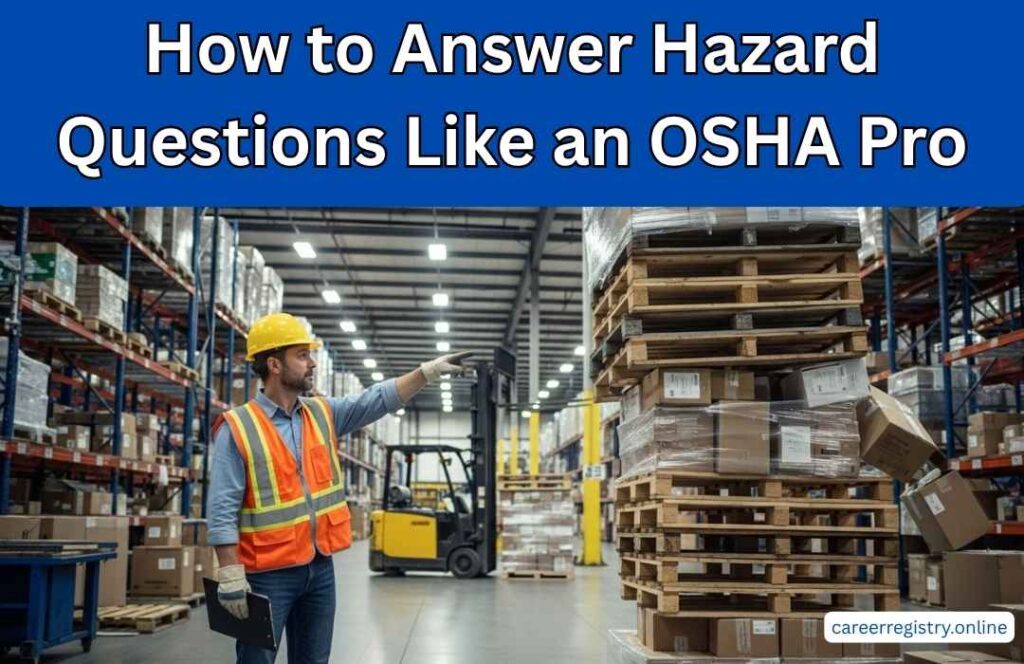
That’s the reality of warehouse safety: hazards are often invisible to the untrained eye—and ignored by the unprepared employee.
As a Certified OSHA Safety Consultant, I’ve interviewed, trained, and audited hundreds of warehouse workers across states like California, Illinois, and Pennsylvania. And I can tell you this with certainty:
This one interview question—“Tell me about a time you spotted a safety hazard”—can decide whether you get hired or rejected.
Why? Because employers aren’t just hiring labor—they’re hiring risk awareness.
According to the Bureau of Labor Statistics, warehouse and transportation workers consistently rank among the highest for workplace injuries in the U.S. Meanwhile, the Occupational Safety and Health Administration enforces strict regulations under 29 CFR 1910, holding employers accountable for preventable hazards.
So when an interviewer asks this question, they are silently evaluating:
- Can you recognize danger before it causes harm?
- Do you take initiative or wait for instructions?
- Will you protect the company from costly OSHA violations?
In this guide, I’ll show you exactly how to answer this question using real-world experience, OSHA-backed standards, and proven hiring strategies. I’ll also share mistakes I’ve personally seen candidates make—mistakes that cost them the job.
The 2026 Warehouse Safety Landscape & Legal Standards
Why Safety Awareness Is Non-Negotiable in 2026
Warehouse operations in 2026 are faster, more automated, and more demanding than ever. With the rise of e-commerce giants like Amazon and Walmart distribution networks, workers are under constant pressure to meet performance quotas.
But here’s the truth most job seekers don’t realize:
Speed without safety is a liability.
From my field inspections, the most common hazards I continue to see include:
- Improperly stacked pallets
- Blocked emergency exits
- Forklift blind-spot collisions
- Slippery floors due to spills
- कर्मचारियों ignoring PPE (Personal Protective Equipment)
And these aren’t minor issues—they are direct violations of OSHA standards.
Key OSHA Regulations You Must Understand
The Occupational Safety and Health Administration outlines warehouse safety requirements under 29 CFR 1910 (General Industry Standards). Here are some critical areas relevant to your interview answer:
1. Walking-Working Surfaces (29 CFR 1910 Subpart D)
- Floors must be clean, dry, and hazard-free
- Spills must be addressed immediately
2. Material Handling & Storage (1910.176)
- Materials must be stacked securely
- Aisles must remain clear
3. Powered Industrial Trucks (1910.178)
- Forklift operators must be trained and certified
- Unsafe operation is a major OSHA violation
4. Personal Protective Equipment (1910 Subpart I)
- Employers must provide PPE
- Employees must use it correctly
Pro Tip (From My Experience):
During interviews, candidates who casually reference OSHA standards—even indirectly—instantly stand out. You don’t need to quote laws word-for-word, but showing awareness signals professionalism.
What the Data Says: Injury Trends in U.S. Warehouses
Here’s a simplified breakdown based on recent data from the Bureau of Labor Statistics:
| Hazard Type | % of Warehouse Injuries | Common Cause |
|---|---|---|
| Overexertion | 30%+ | Lifting improperly |
| Slips, Trips, Falls | 25% | Wet or cluttered floors |
| Forklift Accidents | 15% | Poor visibility or training |
| Falling Objects | 10% | Unsafe stacking |
| Repetitive Motion Injuries | 10% | Poor ergonomics |
What this means for your interview:
If your answer includes one of these real hazards, it immediately becomes more credible and aligned with actual industry risks.
Employer Expectations in Key U.S. States
Different states enforce safety with varying intensity, but the expectations are universally high:
- California (Cal/OSHA): Strictest enforcement; heavy penalties for violations
- Texas: High warehouse volume; strong focus on operational safety
- Illinois: Increasing emphasis on worker protection laws
From my consulting work, I’ve seen companies reject candidates simply because their answers showed passive behavior—like noticing a hazard but doing nothing.
Why This Question Is Really About Liability
Let me be direct:
When you answer this question, the hiring manager is thinking:
- “Will this person prevent accidents—or cause them?”
- “Will this employee report hazards or ignore them?”
- “Could this person help us avoid an OSHA inspection failure?”
In one audit in Los Angeles, California, a company faced fines exceeding $70,000 because workers failed to report a recurring hazard involving unsecured loads. That’s the kind of risk employers are trying to avoid.
Common Mistakes I See Candidates Make
After years of interviewing and training, here are the biggest mistakes:
1. Giving Vague Answers
“I saw something unsafe and told my manager.”
This shows zero depth.
2. Not Taking Action
Just spotting a hazard isn’t enough—employers want action.
3. Ignoring Results
If you don’t explain what happened after, your answer feels incomplete.
4. Choosing Unrealistic Examples
Overly dramatic stories can sound fake. Stick to real, common hazards.
Career Disclaimer
This article is based on professional experience as a safety consultant and publicly available U.S. labor data. It is intended for educational and career guidance purposes only. For official safety compliance requirements, always refer directly to OSHA regulations or consult a licensed workplace safety professional.
Step-by-Step Guide Using the STAR Method (What Actually Gets You Hired)
If there’s one framework I’ve seen consistently separate hired candidates from rejected ones, it’s the STAR method:
- Situation
- Task
- Action
- Result
But here’s the reality: most candidates think they’re using STAR—they’re not. They either skip critical details or fail to demonstrate real safety awareness.
Let me walk you through how to do this the right way, based on what I’ve personally seen hiring managers respond to in warehouse interviews across the U.S.
Step 1: Situation — Choose a Real, Common Hazard (Not a Dramatic Story)
Your goal here is simple: prove you can recognize real-world risks.
Strong examples include:
- Unstable pallet stacking
- Oil or water spills on the floor
- Blocked emergency exits
- Forklift operating in a congested area
Weak Example (What I hear too often):
“I once saw a dangerous situation in the warehouse.”
This tells the interviewer nothing.
Strong Example (What works):
“While working in a distribution warehouse in Illinois, I noticed a pallet stacked above safe height limits and leaning slightly into a forklift aisle.”
That level of detail signals experience + awareness.
Pro Tip (From My Field Audits):
If your example involves forklifts or falling objects, you immediately align with high-risk OSHA categories—which makes your answer more credible.
Step 2: Task — Show Responsibility (Even If It Wasn’t Your Job)
This is where many candidates fail.
They describe the situation—but don’t explain why it mattered to them.
Employers want to see ownership, not job title limitations.
Weak Approach:
“It wasn’t my responsibility, but I noticed it.”
Strong Approach:
“I understood that unsecured loads can lead to serious injuries, so I took it as my responsibility to address the risk immediately.”
You’re signaling:
- Awareness of consequences
- Initiative
- Safety-first mindset
Step 3: Action — This Is the Make-or-Break Moment
From my experience, this is where hiring decisions are made.
Employers want to know:
- Did you act immediately?
- Did you follow proper protocol?
- Did you prevent escalation?
What Strong Actions Look Like:
- Securing the hazard (if safe to do so)
- Alerting coworkers in the area
- Reporting to a supervisor
- Following internal safety procedures
Example of a High-Impact Action Statement:
“I immediately marked the area to prevent forklift traffic, informed my supervisor, and worked with the team to safely restack the pallet according to warehouse safety guidelines.”
Notice what this does:
- Shows urgency
- Shows teamwork
- Shows compliance with procedures
Pro Tip (Insider Insight):
Never say “I ignored it” or “I waited.”
Even hesitation can signal liability to employers.
Step 4: Result — Quantify Impact (This Is Where You Win the Interview)
Most candidates either skip this or give a weak ending.
But hiring managers want results—not just actions.
Weak Result:
“It got fixed.”
Strong Result:
“As a result, we eliminated a potential falling-object hazard, prevented possible injury, and the supervisor later reinforced proper stacking procedures across the team.”
Even better if you can add:
- “No incidents occurred afterward”
- “Management appreciated the proactive approach”
A Complete Winning Answer (Put It All Together)
Here’s a polished example you can model:
“While working in a warehouse in Texas, I noticed a pallet stacked above safe height limits and leaning into a forklift aisle. I knew this could lead to falling objects or a collision, so I took responsibility to address it immediately. I alerted nearby workers, marked the area to prevent traffic, and informed my supervisor. We then safely restacked the materials according to guidelines. As a result, we eliminated the hazard and reinforced safer stacking practices across the team.”
That answer hits every point:
- Realistic hazard
- Clear action
- Measurable outcome
- Safety mindset
Real-World Case Scenarios & Detailed Comparison Table
Scenario 1: The Spill That Everyone Ignored
In a warehouse I audited in Pennsylvania, a small hydraulic oil leak went unnoticed for hours. Workers stepped over it instead of reporting it.
Eventually, a worker slipped and suffered a back injury—resulting in:
- Lost workdays
- Workers’ compensation claim
- OSHA reporting requirements
Lesson:
Small hazards become big liabilities when ignored.
Scenario 2: Forklift Blind Spot Near Miss
In a California distribution center, a worker noticed forklifts turning sharply in a blind corner.
One employee proactively:
- Suggested placing a convex mirror
- Reported visibility concerns
That simple action prevented a collision that could have been fatal.
Scenario 3: Improper PPE Usage
In Chicago, Illinois, I observed workers handling materials without gloves.
One worker stood out during interviews because he explained how he:
- Identified the risk
- Reminded coworkers
- Reported PPE shortages
He got hired. Others didn’t.
Comparison Table: Weak vs Strong Interview Answers
| Criteria | Weak Answer | Strong Answer |
|---|---|---|
| Specificity | Vague situation | Clearly defined hazard |
| Responsibility | “Not my job” attitude | Takes ownership |
| Action Taken | Minimal or delayed | Immediate, structured response |
| OSHA Awareness | None | Implied understanding of safety standards |
| Result | No clear outcome | Measurable safety improvement |
| Credibility | Sounds generic | Feels real and experience-based |
Hiring Manager Psychology (What They’re Really Thinking)
After sitting in on hiring panels in multiple states, I can tell you:
When you give a strong answer, the interviewer thinks:
- “This person will reduce workplace risk.”
- “They won’t ignore safety issues.”
- “They could grow into a leadership role.”
When you give a weak answer:
- “This candidate might cost us money.”
- “They lack awareness.”
- “They’re a potential liability.”
Field-Tested Pro Tips (From My Experience)
- Use simple, clear language—don’t overcomplicate
- Stick to realistic warehouse scenarios
- Show action, not just observation
- Always include a positive outcome
- Mention teamwork when possible
Health, Longevity, & Salary Growth Secrets (What Most Workers Overlook)
Why Safety Awareness Directly Impacts Your Career Growth
Early in my consulting career, I worked with a warehouse in Columbus, Ohio where two employees started at the same time. One focused only on speed. The other consistently reported hazards, followed protocols, and helped enforce safety practices.
Within 18 months:
- The first worker remained in the same role
- The second was promoted to shift supervisor
The difference wasn’t skill—it was safety mindset
Employers in the U.S. don’t just reward productivity—they reward risk reduction.
According to the Bureau of Labor Statistics, workplace injuries cost businesses billions annually in compensation, lost productivity, and compliance penalties. Employees who actively prevent those losses become high-value assets.
How Safety Skills Increase Your Salary (Real U.S. Insights)
From my direct experience across warehouses in Texas, California, and Illinois, here’s how safety awareness translates into earnings:
| Role | Average Salary (USD) | Impact of Safety Skills |
|---|---|---|
| Warehouse Associate | $32,000 – $42,000 | Basic safety awareness required |
| Forklift Operator | $38,000 – $50,000 | Certification + hazard awareness increases pay |
| Shift Supervisor | $50,000 – $65,000 | Safety leadership is critical |
| Safety Coordinator | $60,000 – $80,000 | OSHA knowledge required |
| Safety Manager | $75,000 – $100,000+ | Advanced compliance and audit experience |
What I’ve Seen First-Hand:
Candidates who mention safety actions in interviews are far more likely to:
- Get hired faster
- Be trusted with responsibility
- Be considered for promotions
Certifications That Boost Your Career Instantly
If you want to stand out beyond just interview answers, consider:
- OSHA 10-Hour General Industry Certification
- OSHA 30-Hour Certification
- Forklift Operator Certification
- First Aid / CPR Certification
These are aligned with guidelines from the Occupational Safety and Health Administration and widely recognized across U.S. employers.
Pro Tip (From My Consulting Work):
Even mentioning “I’m currently pursuing OSHA 10 certification” during an interview can give you a competitive edge.
Health & Longevity: The Hidden Benefit of Safety Awareness
Let me be blunt—warehouse injuries don’t just affect your job. They affect your life.
I’ve personally seen:
- Back injuries that ended careers
- Slips that caused long-term mobility issues
- Repetitive strain injuries that built up over years
Most of these weren’t freak accidents. They were preventable hazards ignored over time.
Top Long-Term Risks in Warehousing:
- Chronic back pain (improper lifting)
- Joint damage (repetitive motion)
- Head injuries (falling objects)
- Fatigue-related accidents
What Smart Workers Do Differently:
- They speak up
- They follow procedures
- They protect themselves—even when others don’t
Safety Mindset = Leadership Potential
From a hiring perspective, safety awareness signals something deeper:
- Discipline
- Responsibility
- Situational awareness
- Team leadership
That’s why many warehouse supervisors and managers start as workers who simply paid attention to safety details.
FAQs
1. What if I’ve never worked in a warehouse before?
You can still answer effectively by using a similar environment:
1. Retail stockroom
2. Construction site
3. Any job involving physical work
Focus on:
1. Identifying a hazard
2. Taking action
3. Preventing harm
Employers value mindset over experience.
2. Can I create a hypothetical answer if I don’t have real experience?
It’s better to adapt a real-life situation, even from outside work.
Avoid clearly fictional answers. Interviewers can usually tell.
3. How long should my answer be?
Ideal length:
1. 45 to 90 seconds
2. Structured and concise
Too short = lacks detail
4. Should I mention OSHA in my answer?
Yes—but naturally.
Example:
“I followed proper safety procedures”
or
“I ensured it was handled according to safety guidelines”
No need to sound like a textbook.
5. What’s the biggest mistake candidates make?
From my experience:
They describe the hazard—but not the action.
Remember:
Spotting ≠ Solving
Employers hire people who act.
6. Does this question matter for entry-level jobs?
Absolutely.
In fact, it matters more because:
1. You have less experience to prove yourself
2. Safety awareness becomes your differentiator
Career & Safety Disclaimer
This content is based on professional experience in U.S. workplace safety consulting and publicly available labor data. It is intended for educational and career guidance purposes only. For official compliance requirements, always consult the Occupational Safety and Health Administration or a certified safety professional.
Conclusion
Mastering your answer to “Tell me about a time you spotted a safety hazard in the warehouse” is more than interview prep—it’s proof of your professional mindset. Employers across the U.S. are not just looking for workers; they are looking for individuals who can identify risks, take immediate action, and protect both people and operations.
When you structure your answer using the STAR method and back it with realistic examples, you position yourself as a low-risk, high-value hire. Practice your response, refine your delivery, and align it with real OSHA expectations. If you take this seriously, you won’t just pass interviews—you’ll build a safer, more profitable career path.
External Link Suggestions
- Occupational Safety and Health Administration
Official warehouse safety guidelines and standards (29 CFR 1910)
http://www.osha.gov/laws-regs/regulations/standardnumber/1910 - Bureau of Labor Statistics
Injury statistics and employment data for warehouse workers
https://www.bls.gov/iif/ - National Institute for Occupational Safety and Health
Research-backed workplace safety recommendations and hazard prevention
https://www.cdc.gov/niosh/index.html
Also Check:- How to List “Reach Truck” Experience on a Resume Without Being Certified. (OSHA-Safe Strategy for 2026)